
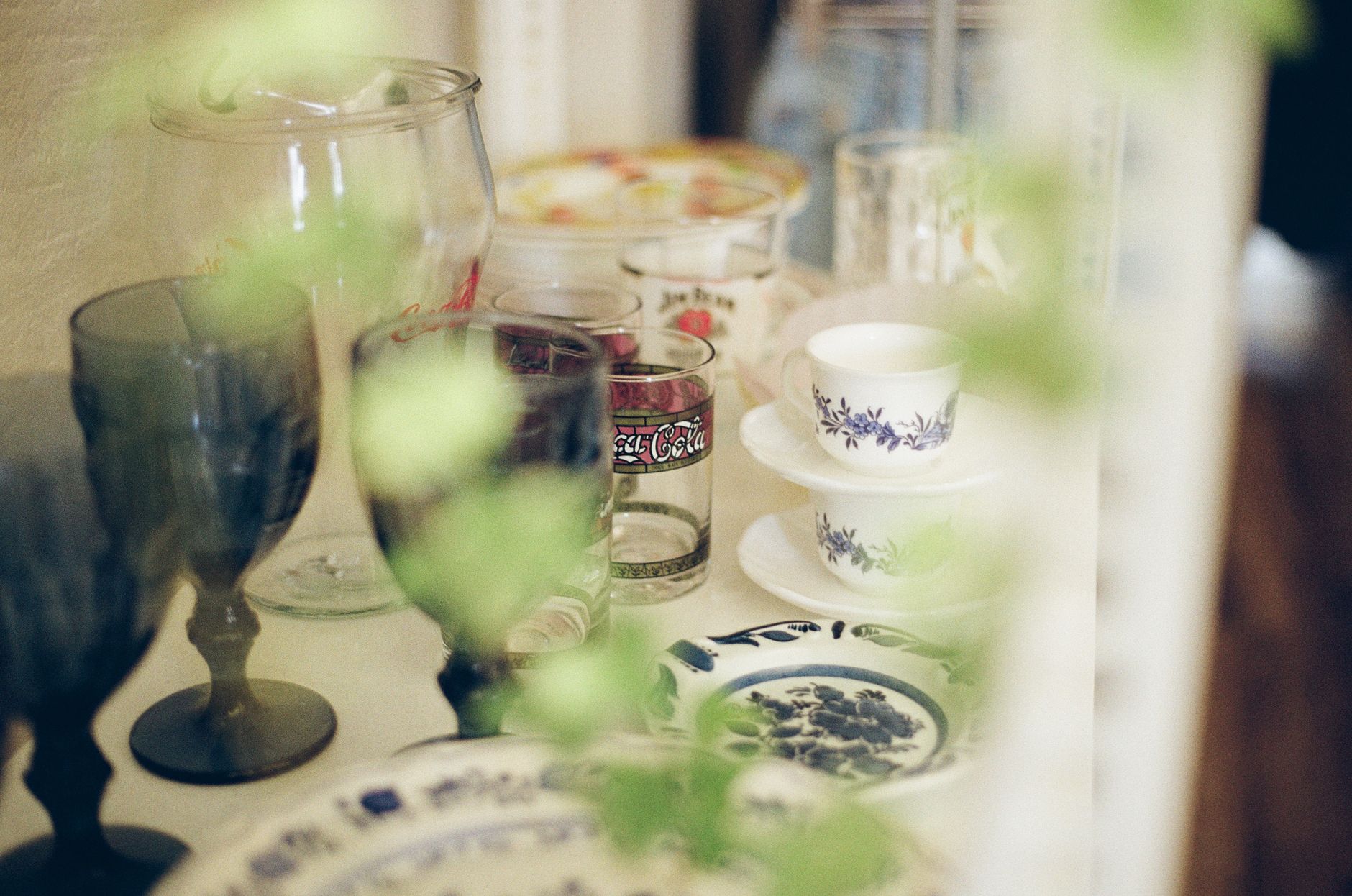
Vintage glassware is everywhere right now. Depression-era tumblers, uranium glass compotes, mid-century coloured goblets, and pressed glass cake stands are turning up at op shops and estate sales across Australia, often for very little money. The collecting part is easy. The harder question is what to do with them once you get them home. A shelf of mismatched glass can look stunning or chaotic depending on how you approach it, and most of the difference comes down to a handful of decisions made before anything goes up.
Start with a focal point, not a collection
The biggest mistake people make when displaying vintage glassware is trying to show everything at once. A dozen pieces crammed onto one shelf reads as clutter, even when each piece is genuinely beautiful. Pick 3 to 5 pieces that share something: a colour family, a silhouette, an era, or a material. Build the display around those. The rest can rotate in over time, or live in a cupboard until something comes down.
Light is the most important variable. Glassware that sits against a dark wall in a dim corner does nothing. Place coloured pieces where natural or warm artificial light can pass through them. A windowsill with morning light turns an amber pressed-glass vase into something that looks lit from within. Uranium glass (the pale green pieces that glow under UV) deserves a dedicated shelf where a small UV lamp can do the work at night.
Mixing eras without losing coherence
Vintage glassware spans over a century of design, from Victorian cut crystal to 1970s smoked glass. Mixing eras works well when you hold one element constant. Colour is the easiest anchor: a display of all-clear glass can contain everything from 1920s Depression ware to 1960s Scandinavian modernist pieces without looking muddled. Alternatively, fix the function: a collection of decanters from different decades reads as intentional because the form connects them.
Vary the height. Flat arrangements of same-height pieces look like a supermarket shelf. Use a small timber riser, a stack of old books, or a vintage cake stand to lift one or two pieces above the rest. This creates a visual hierarchy that makes the eye move rather than scan and move on. If you enjoy mixing eras across your whole home, the principles in mixing vintage eras without your home looking cluttered apply directly here: hold one element constant and let the rest vary.
Choosing the right backdrop
Clear glass disappears against a white wall. If you want the pieces to stand out, give them contrast. A painted timber shelf in deep green, charcoal, or navy throws clear and pale-coloured glass into sharp relief. Mirrored backing doubles the visual depth and catches light from multiple angles. Timber panelling adds warmth, which suits amber, brown, and olive-toned glassware particularly well.
A dedicated glass cabinet with LED strip lighting along the top shelf is the most controlled option. It keeps dust off the pieces, allows backlighting, and frames the display as a deliberate choice rather than an overflow situation. Older display cabinets from the 1950s and 1960s work especially well because the proportions were designed for exactly this purpose.
Practical tips for keeping glassware safe
Display and storage aren't separate decisions. Glassware that isn't properly supported chips, slides, and breaks. Use non-slip shelf liner under every piece. It's invisible, cheap, and it prevents the slow creep that leads to a tumbler falling off the edge when someone walks past with a heavy step.
Don't stack glassware unless it's designed for it. Stacking coloured or gilded pieces causes scratching and can crack rims over time. If shelf space is tight, that's a sign to edit the display rather than add a second layer. Pieces worth collecting are worth protecting.
Wash vintage glassware by hand, always. Dishwashers etch old glass, strip gilding, and cloud surfaces permanently. Warm water and a small amount of mild dish soap is enough for most pieces. For cloudy mineral deposits inside decanters, a solution of white vinegar and warm water left to soak for 30 minutes usually clears it. The methods covered in cleaning and restoring vintage pieces at home offer a useful framework for thinking about gentle cleaning more broadly.
Styling glassware with other objects
Glass looks best when it's not surrounded exclusively by more glass. A single ceramic vase or a small bunch of dried botanicals breaks the visual repetition and anchors the display to something organic. A piece of vintage linen laid flat underneath a collection of pressed glass cake stands gives the arrangement warmth and weight.
Don't overlook the floor. Large glass vessels, wide-necked vases, and heavy compotes look confident on the floor beside a sideboard or tucked into the corner of a bookcase. Height variation at that scale makes a room feel considered rather than decorated.
If you're shopping specifically to build out a display, look for pieces from the National Museum of Australia's documented eras of Australian domestic glass production: the 1930s Depression glass period, the post-war utility glass of the late 1940s and early 1950s, and the coloured art glass of the 1960s and 1970s. These three periods produce consistently beautiful objects that work well together because Australian manufacturers were responding to similar aesthetic currents across each decade.
When to stop adding
A display has a natural capacity. When you can't identify the standout piece in 3 seconds, there are too many pieces. Edit ruthlessly. Rotate seasonally if you find yourself attached to everything: amber and amber-brown tones sit well in autumn and winter, clear and pale blue pieces feel right in spring and summer. Rotation keeps the display fresh and means every piece gets its moment rather than disappearing into visual noise.
Vintage glassware collects slowly and displays well for decades when it's chosen and arranged with care. It doesn't need a dedicated room or an expensive cabinet. It needs light, contrast, and enough empty space around each piece to let it be seen properly.