
Vintage maps and travel ephemera sit in a sweet spot that few decorating categories can claim: they're historically interesting, visually beautiful, and almost impossible to replicate with a factory print run. A 1940s railway timetable, a hand-coloured atlas page, a bundle of postcards from places you've never been. Each one carries a story that mass-produced art simply doesn't.
The challenge isn't finding the pieces. Op shops, estate sales, and market stalls across Australia turn them up regularly, often for a few dollars. The challenge is knowing what to do with them once you've got them home, and how to stop a collection tipping from curated into chaotic.
What counts as travel ephemera
The category is broader than most people realise. Beyond the obvious folded road maps, travel ephemera includes luggage labels, hotel receipts, steamer trunk stickers, tourist brochures, postage stamps, airline ticket booklets, and hand-written postcards. Passport-sized booklets, transit maps from foreign cities, even old geography textbooks with illustrated plates all qualify.
Don't overlook the purely functional items. A mid-century Melbourne bus route chart or a 1960s Victorian Railways schedule has as much visual appeal as anything produced for decoration. Domestic pieces like these are easier to find in Australia, and they carry a specific local resonance that imported ephemera can't match.
Where to source vintage maps and ephemera in Australia
Estate sales remain the best single source, particularly for collections that haven't been picked over. When a household is cleared all at once, maps and documents often surface that have never seen a market stall. Knowing how to navigate estate sales and auctions gives you a real advantage here, especially for early access before the general public arrives.
Op shops are inconsistent but worth checking regularly. The Salvos and Vinnies stores in outer suburbs tend to price paper items low because staff aren't always sure of their value. Specialist paper and ephemera dealers operate at larger antique fairs in Melbourne, Sydney, and Adelaide. The Camberwell Sunday Market and the Melbourne Antique and Collectables Market in Prahran both reliably carry map and document sellers.
Online, Etsy has a deep catalogue of vintage maps and ephemera, including Australian sellers offering colonial-era prints and early Federation documents. Prices are generally fair and provenance is often better documented than at a market stall.
How to display maps without them looking flat
The most common mistake is treating a vintage map exactly like a modern art print: centre it, frame it, hang it alone. The result looks like a placeholder. Vintage paper earns its place through layering, grouping, and a little irregularity.
A few approaches that work well:
- The gallery cluster. Group 5 to 9 pieces of varying sizes around a central anchor, such as a large folded map or a framed atlas spread. Keep frames in two tones at most (natural timber and black, or all timber in different widths) to hold the cluster together without matching it into blandness.
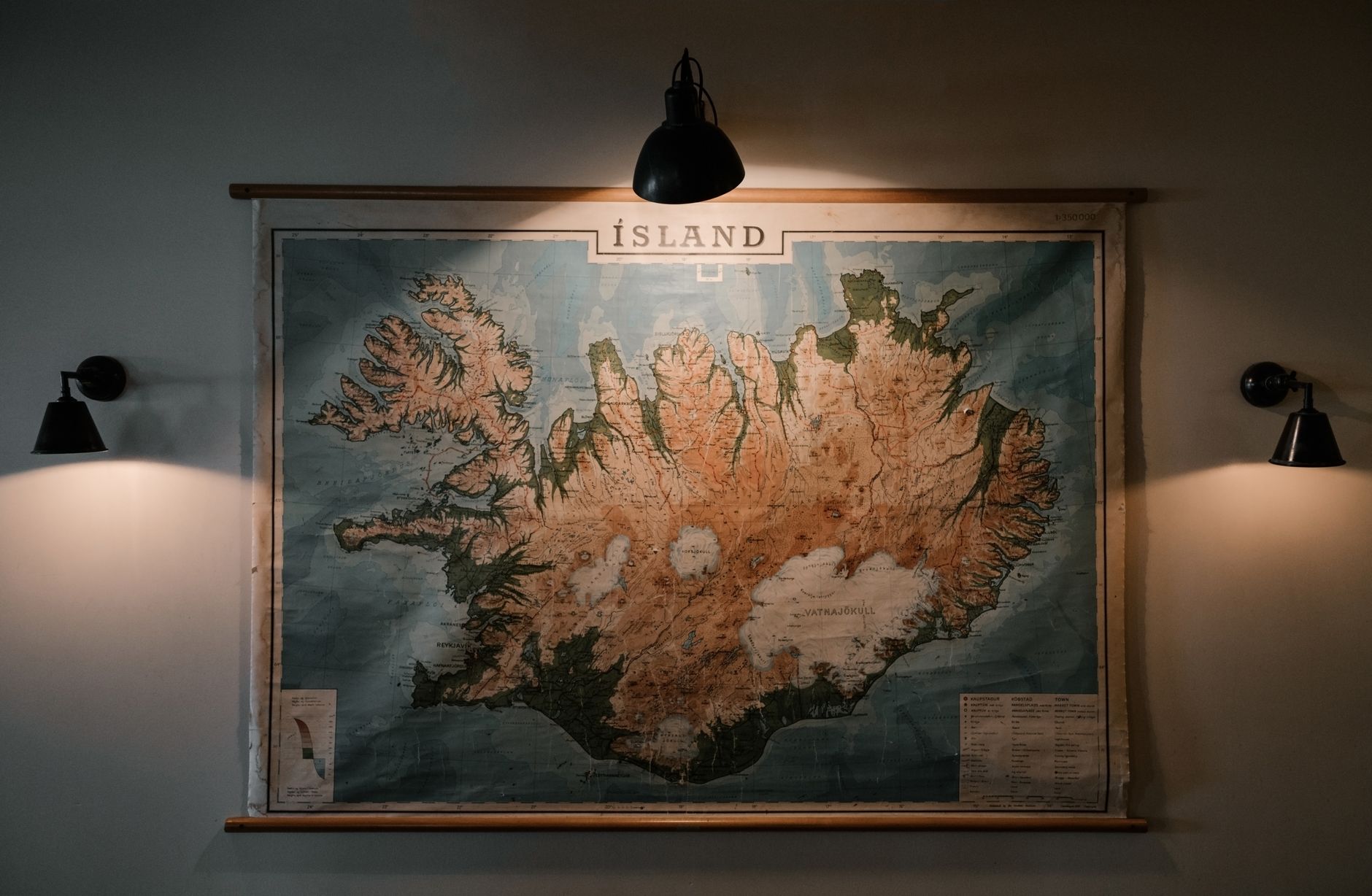
- The map wall. A single oversized map, wheat-pasted directly onto a feature wall or mounted on canvas, works well in a study or hallway. This reads as intentional rather than accidental. Ensure the paper is in good condition first: tears and brown foxing spots that look charming in a frame look like damage at scale.
- The flat lay shelf. Stack folded maps, brochures, and postcard bundles on an open shelf alongside objects: a vintage compass, a small globe, a timber box. The flat ephemera add visual depth without competing for wall space.
Framing matters more with paper than with almost any other collectible. UV-filtering glass is worth the extra cost. Old paper fades fast under direct light, and a piece that looks beautiful today can yellow noticeably within a few years without protection. Simple timber frames with a clean rebate suit most vintage paper. Avoid ornate gold frames unless the piece itself is genuinely decorative (a hand-illustrated map plate, for instance) rather than functional.
Mixing ephemera with other vintage styles
Travel ephemera pairs naturally with mid-century furniture and with the kind of layered, collected look that characterises genuinely lived-in interiors. A cluster of framed maps above a timber sideboard, beside a vintage globe and a ceramic vase, reads as personal and considered. The same cluster above a flat-pack shelf reads as an afterthought.
If you're working to mix vintage eras without the space looking cluttered, ephemera is one of the easier categories to integrate because it's flat and small-scale. It doesn't compete with furniture the way a ceramic collection or a large sculpture might. It fills vertical space and adds warmth without taking up floor area, which makes it particularly useful in smaller rooms.
Colour is the real calibration tool. Most vintage paper sits in a warm range: cream, ochre, sepia, faded olive. This connects naturally with timber, linen, and terracotta. It's less comfortable beside cool greys and stark white walls, though a strong piece, like a large-format map with deep ink tones, can hold its own against a white gallery wall if the framing is confident.
Caring for your collection
Paper is fragile. Direct sunlight is the fastest enemy, followed by humidity, then handling. Keep framed pieces away from north-facing windows where afternoon sun hits hard. In Queensland and coastal New South Wales, humidity silently damages unprotected paper over years. Store unframed pieces flat in acid-free sleeves, not in cardboard boxes or plastic bags.
Don't clean old paper with anything damp. Dry brushing with a soft, natural-bristle brush removes surface dust without wicking moisture into the fibres. If a piece has significant foxing or water damage, a conservator is a better choice than a DIY fix. The cost of professional conservation is almost always less than the cost of making the damage permanent.
A collection that's properly stored and displayed holds its value well. Condition is the single biggest factor in what vintage paper is worth at resale, and a piece that's been kept in acid-free sleeves, out of direct light, will be worth considerably more than the same piece that's been pinned to a corkboard for a decade.
Sourcing locally and thinking small
One of the most rewarding angles on vintage ephemera is staying deliberately local. Maps of the Dandenong Ranges, early Victorian Railways posters, tourist brochures from the Yarra Valley in the 1950s and 60s. These pieces connect a home to its specific place in a way that a Parisian street map never quite can, no matter how beautiful.
State libraries and archives often sell reproduction prints of historical maps and documents, which work well alongside genuine vintage pieces as long as they're framed consistently. The State Library Victoria holds an extensive collection of Victorian cartographic material and offers high-quality reproductions of significant pieces.
Start small. A single well-chosen piece, properly framed and placed with intention, does more for a room than a wall covered in pieces that haven't been edited. Build the collection slowly, keep only the pieces that genuinely interest you, and let the display grow with the same patience the pieces were made with.